This music lesson is brought to you by :

This music lesson is brought to you by :
Music Theory: Lesson 4
The Simple Intervals
By Zack Cart
Prerequisites:
You should be able to understand and perform the concepts and techniques outlined in the following lessons before attempting this lesson:
Music Theory: Lesson 1 - Twelve Note Division of the Octave
Music Theory: Lesson 2 - Notation of the Seven Basic Notes
Music Theory: Lesson 3 - All Twelve Pitches - Modying the Natural Notes
--------------------------------------------------------------------------------------------------
In the previous lesson, we became aquainted with the twelve notes of Western Music Theory, and their placement on the keyboard. In this lesson, we will examine their relationships, relative to one another. Every pair of pitches has a relationship, identified by the difference between the frequencies, or the distance between them. While "distance" is an extremely innacurate description of the this difference, it is commonly used, and it will serve for now to speak of the differences between frequencies as "distance."
This distance is also known as an "interval," which is a much more accurate description. An interval is the relationship between any two distinct pitches. For example, a C and an E form an interval. A Bb and an Eb form an interval. An A and a D# form a interval. For a moment, try playing various intervals at the keyboard by playing two notes simultaeneously. Notice how, depending on which two notes you pick, each interval has a distinct sound, characterized by a sort of pulsing vibration to the tone, and also by something more elusive, closer to an emotive flavor.
Now play around with some intervals played one note at a time. Again, note that each interval has a distinctly different sound from many of the others.
--------------------------------------------------------------------------------------------------
Intervals are classified into twelve basic types. Intervals of the same type have a consistent relationship to one another; they are all the same "distance" apart. For example, look at the keyboard. Every note has two adjacent notes, represented by either a black or white key. Pick any two adjacent keys and play them simultaeneuosly. This forms a distinctly complex, "unpleasant", or dissonant sound. Pick any other two adjacent keys and you will encounter a similar dissonance. Any other two: same again.
There is a reason all these
intervals sound similar, they are all of the same type. For now, we will call
this interval, formed by two adjacent notes, a semitone. From this
semitone, we will identify all twelve intervals available to us in the space of
an octave. (Side note: an octave is another type of interval, which is
characterized by its very simple, pleasant, consonant sound, as you will
remember from Music Theory: Lesson 1.
To classify an interval, all that need be done is to count the semitones separating the notes. For example, any two notes which are one semitone apart, in other words, the adjacent keys we were just playing, will be of the same type of interval. Likewise, and two notes which are twelve semitones apart will form an octave, as we have already discovered.
--------------------------------------------------------------------------------------------------------
There is an additional component in identifying intervals once we begin to truly name them in the Western tradition. We must examine not only the distance between the pitches, but also the distance between the letter names of the note.
We name intervals as numbers, which correspond to the number of note letter names separating the notes. (counting both the starting and ending notes). For example, C up to the next G forms a fifth:
C(1), D(2), E(3), F(4), and G(5).
Now, C to Gb also forms a fifth:
C(1), D(2), E(3), F(4), and Gb(5).
It is only the letters of the note name which matter when arriving at the numerical name of an interval. Ignore sharps, flats, naturals, and semitones for now.
Try counting out a few intervals. Here are a few more examples to help you:
D up to F is a third: D(1), E(2), F(3)
Eb up to C# is a sixth. Eb(1), F(2), G(3), A(4), B(5), C#(6)
F up to Bb is a fourth. F(1), G(2), A(3), Bb(4)
G up to A is a second: G(1), A(2)
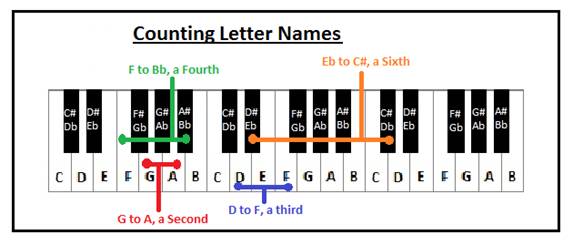
Now, we can also count the intervals downwards. Let's take the same intervals, and try.
F down to D is a third: F(1), E(2), D(3)
C# down to Eb is a 6: C#(1), B(2), A(3), G(4), F(5), Eb(6)
Bb down to F is a fourth: Bb(1), A(2), G(3), F(4)
A down to G is a second: A(1), G(2)
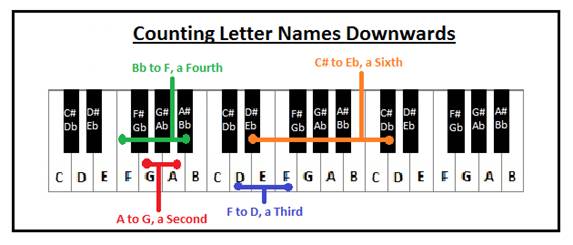
Notice, that even thought the direction in which counted changed, the pitches did not, and so obviously, the notes maintain the same interval.
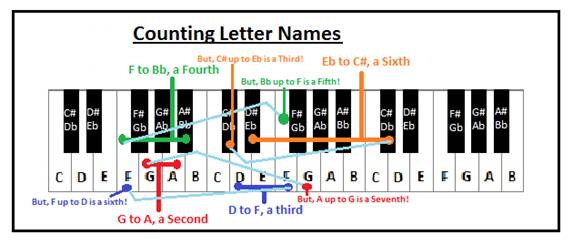
However, if we invert the intervals, this will change. "Inverting" an interval consists of displacing either the lower note up an octave to the next note of the same name, or the higher note down an octave to the next note of the same name. Either will have the same effect on the interval's name. Let's invert the same four intervals and see what happens.
D up to F is a third, but F up to D is a sixth.
Eb up to C# is a sixth,but C# up to Eb is a third.
F up to Bb is a third, but Bb up to F is a fifth.
G up to A is a second, but A up to G is a seventh.
---------------------------------------------------------------------------------------------------------------
This gives us a numerical name for any interval we can play on a keyboard, but there is more! There are kinds of third, kinds of fourth, etc.
We have Five designations for these different kinds or flavour of each numeric interval; Perfect, Augmented, Major, Minor, and Diminished.
Seconds,Thirds, Sixths, and Seventh commonly come in two such "flavors," Major and Minor. More rarely, they can be either Augmented or Diminished.
Unisons (Firsts), Fourths, Fifths, and Octaves (Eights) come in three flavours. Most commonly they are perfect, but they can also be either Augmented or Diminished.
These names determine the exact size of the interval in semitones. For example, F up to A is a third, but so is F to Ab, and F to A#. Obviously, these intervals will sound quite different from one another. While all are thirds, the are different kinds of thirds. F to A is a Major third, F to Ab is a minor third, and F to A# is a rare Augmented third.
To count the number of semitones in an interval, simply count the intermediary keys on the keyboard, as well as the final key.
For example, from C to E is four semitones. C#/Db(1), D(2), D#/Eb(3), E(4)
Bb to F is seven semitones. B(1), C(2), C#/Db(3), D(4), D#/Eb(5), E(6), F(7)
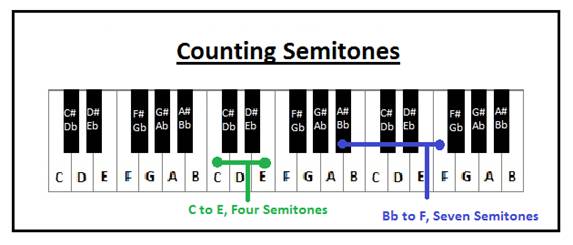
We now know how to determine the Numeric name of the interval, and how to count semitones. By finding both the distance by Letter name, and the distance in semitones, you can consult the chart below to determine the name of any interval within a single octave.
|
0 Semitones (Same note) |
Perfect Unison(abbr. "Unison"). Rarely, Diminished Second or Augmented Seventh. |
|
1 Semitones |
Minor Second. Rarely, Augmented Unison. |
|
2 Semitones |
Major Second. Rarely, Diminished Third. |
|
3 Semitones |
Minor Third or Augmented Second. |
|
4 Semitones |
Major Third. Rarely, Diminished Fourth. |
|
5 Semitones |
Perfect Fourth (abbr. "Fourth"). Rarely, Augmented Third. |
|
6 Semitones |
Perfect Fourth or Diminished Fifth. AKA "Tritone." |
|
7 Semitones |
Perfect Fifth (abbr. "Fifth"). Rarely, Diminished Sixth. |
|
8 Semitones |
Minor Sixth or Augmented Fifth. |
|
9 Semitones |
Major Sixth or Diminished Seventh. |
|
10 Semitones |
Minor Seventh. Rarely, Augmented Sixth. |
|
11 Semitones |
Major Seventh. Rarely, Diminished Octave. |
|
12 Semitones |
Perfect Octave (abbr. "Octave") |
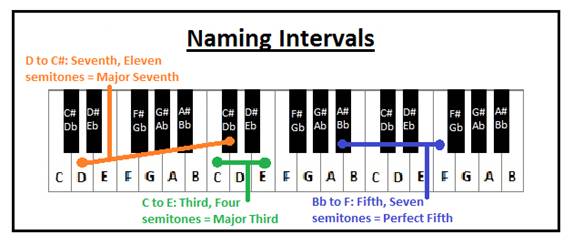
The Following diagram shows the naming of three intervals, using a keyboard.
D to C# is seven note names apart, and eleven semitones apart, resulting in a major seventh on the above chart.
C to E is three note names apart, and four semitones apart, resulting in a major third on the above chart.
D to C# is five note names apart, and seven semitones apart, resulting in a major seventh on the above chart.
To practice creating and identifying intervals, follow a methodology similar to the previous theory lessons. Write the a series of intervals in music notation, identify the interval name, and then play the interval on the keyboard, on your primary instrument, and attempt to sing it back, one note at a time, where neccesary, all the while listening carefully to the sound of the interval. On instruments such as the keyboard, which can play mulitple simultaneous notes, play the intervals one note at a time, and also both notes at once. Remember, listening carefully!
Also to the reverse, play an interval, listen to it, think about how it sounds, and then notate it and identify its name.
Continue both of these excercises until you can swiftly identify intervals without referencing any of the charts or keyboards. In order to understand the very basics of music theory, interval recognition must be as swift as word recognition is for you now.